The Effect of Shadow Liquidity on Futures Trading Cost Estimation
Market impact modeling for futures is challenging. A big reason is "shadow liquidity".
Most firms try to graduate their equity impact models into futures. Equity models typically use a "pooled" approach: one model for all stocks, or for a group such as large cap or mid cap. That approach requires normalization, and the usual choice is to normalize expected cost by volatility and order size by average daily volume. In other words, you assume that trading 10K shares of a stock with 100K ADV is going to have the same impact as trading 1M shares of a stock that trades 10M ADV.
In futures, that breaks down. Volume is not a good proxy for the liquidity of a particular contract, because volume in correlated contracts (other expiries, the cash market) affects how liquid any single contract is.
The chart below presents an interesting analysis. After normalizing for volume, the cost of crude contracts in the second expiry (CL_2) is much lower than the cost of the most active contract (CL_1). The reason is the basis trade between the first and second contract: once prices deviate from a fair basis, arbitrage forces will shift liquidity from the most active contract into the second.
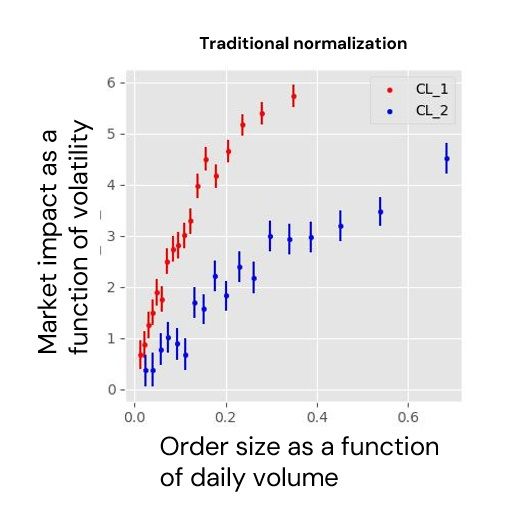
There are three consequences for this "volume is liquidity" and "participation rate focused" approach in portfolio optimization and execution for futures:
- A cost model built on volume normalization will overestimate the cost of crude contracts that are not the most active.
- Portfolio optimizations using arbitrary participation ceilings will be too constraining.
- Execution providers whose IS algos set participation rates by rule of thumb, rather than by expected impact at a given participation rate, will trade the less active contracts too slowly.
We addressed this challenge in Pulse, the BestEx Research futures transaction cost model, which estimates market impact impact from the average shape of the order book instead of from volume. The same model drives speed optimization inside our execution algos. The model is available via API as well as MCP connector (Pulse AI) and the model's methodology is fully transparent to our clients via white paper. For more information about Pulse, reach out to us at futures@bestexresearch.com.